The Accounting Firm You're Hiring Might Be a Private Equity Portfolio Company Now

Lorem ipsum dolor sit amet, consectetur adipiscing elit. Donec rhoncus neque sed nibh sagittis, fringilla porttitor ipsum tristique. Nulla interdum ex et nisi vehicula, id laoreet nisl ultricies. Phasellus vitae magna ac lacus dictum tincidunt. Sed iaculis metus nec viverra pulvinar. Etiam id nisi eu turpis mattis imperdiet ac ac tortor. Aliquam at ipsum dui. Etiam pharetra consequat massa. Aenean nec lectus sit amet metus pharetra dapibus. Pellentesque interdum ex eget nisi fringilla, id semper erat rhoncus. Suspendisse lectus leo, malesuada pharetra commodo a, sollicitudin eu erat. Nullam justo nisl, tincidunt vel auctor id, luctus a tellus.
Aliquam convallis condimentum volutpat
Pellentesque sollicitudin mauris sit amet enim volutpat, at faucibus sem laoreet. Morbi egestas ex non orci interdum, ut elementum orci faucibus. Maecenas et sem convallis erat dignissim facilisis. Quisque purus sapien, pellentesque euismod varius id, fermentum nec nibh. Integer commodo dignissim ipsum, ac accumsan metus fringilla sit amet. Aenean aliquam sem finibus tempor venenatis. Aliquam ac facilisis turpis, eu posuere ipsum.

In nisi dui, ultricies sit amet gravida vel, ullamcorper vel mauris. Aliquam nec sapien odio. Sed vitae suscipit felis. Nullam semper blandit lectus, eu finibus urna fermentum et. Aliquam vehicula ligula nibh, non efficitur massa iaculis et. Vestibulum vitae euismod odio, non maximus nulla. Sed viverra porta enim ac interdum. Maecenas auctor tristique auctor. Nullam et neque nec tortor malesuada ullamcorper. Pellentesque ac fringilla ante, non convallis est. Proin velit augue, rutrum vitae ipsum vel, malesuada dictum urna. Nunc vulputate sit amet odio vitae ullamcorper. Nullam suscipit ornare eros, et viverra sapien hendrerit quis. Donec odio eros, ultricies a risus quis, efficitur elementum turpis. Etiam interdum diam quis turpis ultricies.
Sed euismod quam vestibulum
Sed non sapien eros. Duis fringilla fringilla lectus sit amet aliquam. Aliquam erat volutpat. Vivamus molestie, felis rutrum luctus pulvinar, libero metus eleifend mauris, semper malesuada ante eros vitae eros. Phasellus vitae dolor faucibus, laoreet lectus quis, placerat nisi. Nam ornare nulla id est aliquet, quis fringilla neque congue. Duis facilisis sed massa vel bibendum. Curabitur sollicitudin tristique commodo. Vivamus facilisis venenatis nibh. Integer placerat elementum felis, id consequat lorem consectetur a. Duis laoreet sit amet nisl in eleifend. Interdum et malesuada fames ac ante ipsum primis in faucibus.
Proin eros lacus, pellentesque sed vehicula a, luctus non nibh. Nulla diam sem, posuere ac odio varius, ultrices tristique nibh. Morbi dictum scelerisque convallis. Praesent faucibus lorem lacus, id luctus justo feugiat et. Curabitur eget tellus non nisi interdum blandit. Maecenas pulvinar est sed ex elementum, ac commodo diam bibendum. Nulla auctor dolor felis, sit amet euismod ante eleifend non. Donec id neque magna.
When you hire an accounting or advisory firm, you think you're buying a relationship - a named partner who knows your business, continuity year over year, judgment you can call at 9pm during the audit. That's the pitch, and for decades it was mostly true. But there's a good chance the firm you're about to sign with is now owned, in whole or in part, by a private equity fund optimizing for a five-year exit. And that quietly changes what you're actually buying.
This isn't a fringe trend anymore. Per CPA Trendlines' deal tracker, there were 180 private equity deals involving accounting firms in 2025 alone, and around 250 since 2019. The names aren't small, either: Grant Thornton (New Mountain Capital), Citrin Cooperman (Blackstone), Cherry Bekaert (Parthenon), Sikich (Bain Capital). And in one of the biggest moves yet, Baker Tilly and Moss Adams combined in April 2025 to form the sixth-largest advisory CPA firm in the US, backed by Hellman & Friedman. If you're choosing among mid-tier and national firms, you are very likely choosing among portfolio companies.
Why this is happening
It's the shortage, mostly. Firms are starved for talent, partners are aging out, and the old model - where young accountants bought into the partnership over decades - is breaking down because there aren't enough young accountants buying in. PE shows up with capital to fund technology, acquisitions, and succession for retiring partners who want to cash out. From the firm's side it often makes real sense. The question is what it means for you, the client, and almost nobody is talking about that side honestly.
What actually changes when a firm goes PE-backed
Let me be fair first: PE money can make a firm better. More investment in technology and AI tooling, more capacity, broader service lines, a real succession plan instead of a partner walking out the door with all the institutional knowledge. Those are genuine upsides and you should weigh them.
But the incentives shift, and you should go in clear-eyed about how. A PE-backed firm is running on a clock - the fund typically wants an exit in roughly five years, which means the pressure is on EBITDA growth, utilization, and efficiency on a defined timeline. In practice that can mean a few things worth watching for: the named partner who sold you on the relationship may be on a retirement glide path as part of the deal; pricing and scope may get optimized more aggressively; and the firm may push standardized, productized services over the bespoke judgment work you might actually be paying for. None of that is automatically bad - but it's a different animal than the old eat-what-you-kill partnership, and you should price that difference in.
The buyer-side diligence nobody runs
Here's the move, and it's simple: run diligence on your firm the way they'd run it on an acquisition target. When you're evaluating or renewing with a firm, ask the questions the PE ownership makes relevant:
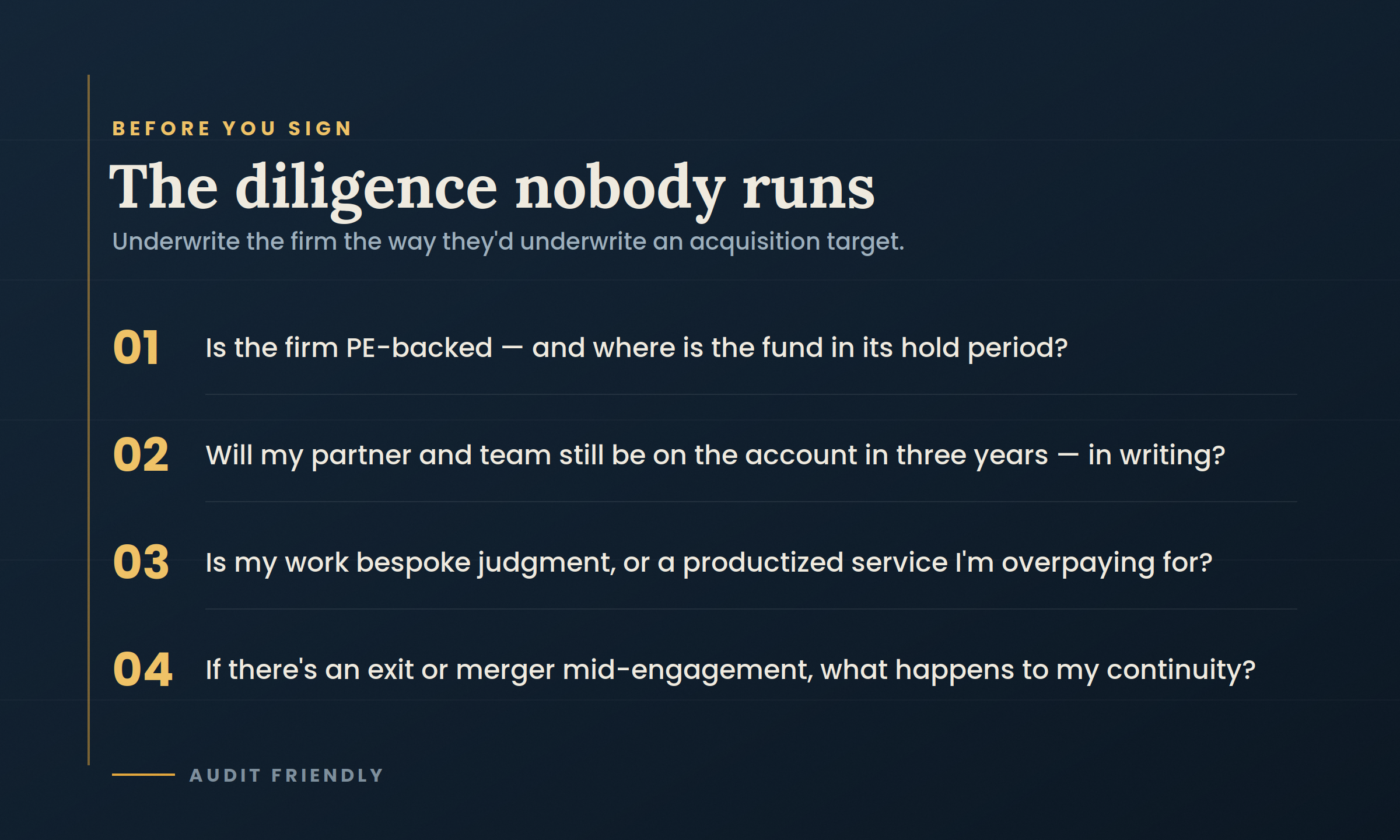
Is the firm PE-backed or independent - and if backed, where is the fund in its hold period? (A fund two years from exit behaves differently than one that just invested.) Will the partner and team on my account still be here in three years, in writing? Is the work I need genuinely bespoke judgment, or something they're productizing - and am I priced accordingly? If there's an exit or another merger mid-engagement, what happens to my continuity? You are allowed to ask these. The firms that answer them cleanly are the ones worth hiring.
This is bigger than it looks for your own hiring, too
One more angle most people miss, and it's one we can see directly in our data. The PE-backed firms aren't just service providers - they're some of the most active employers in the entire profession. Across the accounting and finance roles we track, firms like Cherry Bekaert, BDO, Baker Tilly, and RSM consistently rank among the highest-volume hirers. So this consolidation isn't an abstract industry story happening somewhere else - it's reshaping who your team's next job offer comes from, who your competitors for talent are, and what "working at a firm" even means now. The roll-up is happening on both sides of the desk: the firm you hire and the firm that hires your people may be the same portfolio.
What I'd do
Don't avoid PE-backed firms - that's neither possible nor smart, since some of the best-resourced firms in the country are now backed. Just stop assuming the old relationship model is what you're buying. Treat firm selection as a real underwriting decision: know who owns them, know where they are in the hold period, get continuity commitments in writing, and separate the bespoke-judgment work (which you want a human partner for) from the productized work (which you should pay commodity prices for). The firms are getting more sophisticated about extracting value. You should get equally sophisticated about buying it.
If you're weighing firms right now, our firms directory is built to help you compare them on what actually matters - specialization, region, and fit - so you can ask the sharper questions before you sign.
Frequently asked questions
How common is private equity ownership of accounting firms now?
Very. Per CPA Trendlines' tracker, there were roughly 180 PE deals involving accounting firms in 2025 and about 250 since 2019. Major firms including Grant Thornton (New Mountain Capital), Citrin Cooperman (Blackstone), and Cherry Bekaert (Parthenon) are PE-backed, and Baker Tilly/Moss Adams merged in 2025 backed by Hellman & Friedman.
Is it bad to hire a PE-backed accounting firm?
Not inherently. PE capital can fund better technology, more capacity, and real succession planning. But the incentives differ - a fund typically targets an exit in about five years, which pressures EBITDA growth and can affect partner continuity, pricing, and how bespoke vs. productized the service is. The point is to go in informed, not to avoid them.
What should I ask before hiring an accounting firm now?
Ask whether the firm is PE-backed and where the fund is in its hold period; whether your named partner and team will remain on the account in three years (in writing); whether your work is bespoke judgment or a productized service; and what happens to continuity if there's an exit or merger mid-engagement.
Why is private equity buying accounting firms?
Mainly the talent shortage and partner succession crisis. With fewer young accountants buying into partnerships and many partners aging out, PE provides capital for technology, acquisitions, and partner buyouts. It's often rational for the firm - but it changes the firm's incentives in ways clients should account for.
Choosing a firm is a bigger decision than it used to be. Compare accounting, tax, and advisory firms by specialization, region, and size on the Audit Friendly firms directory.


.jpg)